Dive Travel ·
Where to Meet Whale Sharks: Nine Destinations, Different Rules—and No Guarantees
From Galápagos scuba dives to Ningaloo snorkel trips, whale shark encounters depend on more than a season chart. New research and recent operator reports show why travelers should look closely at access, animal welfare and actual sightings.
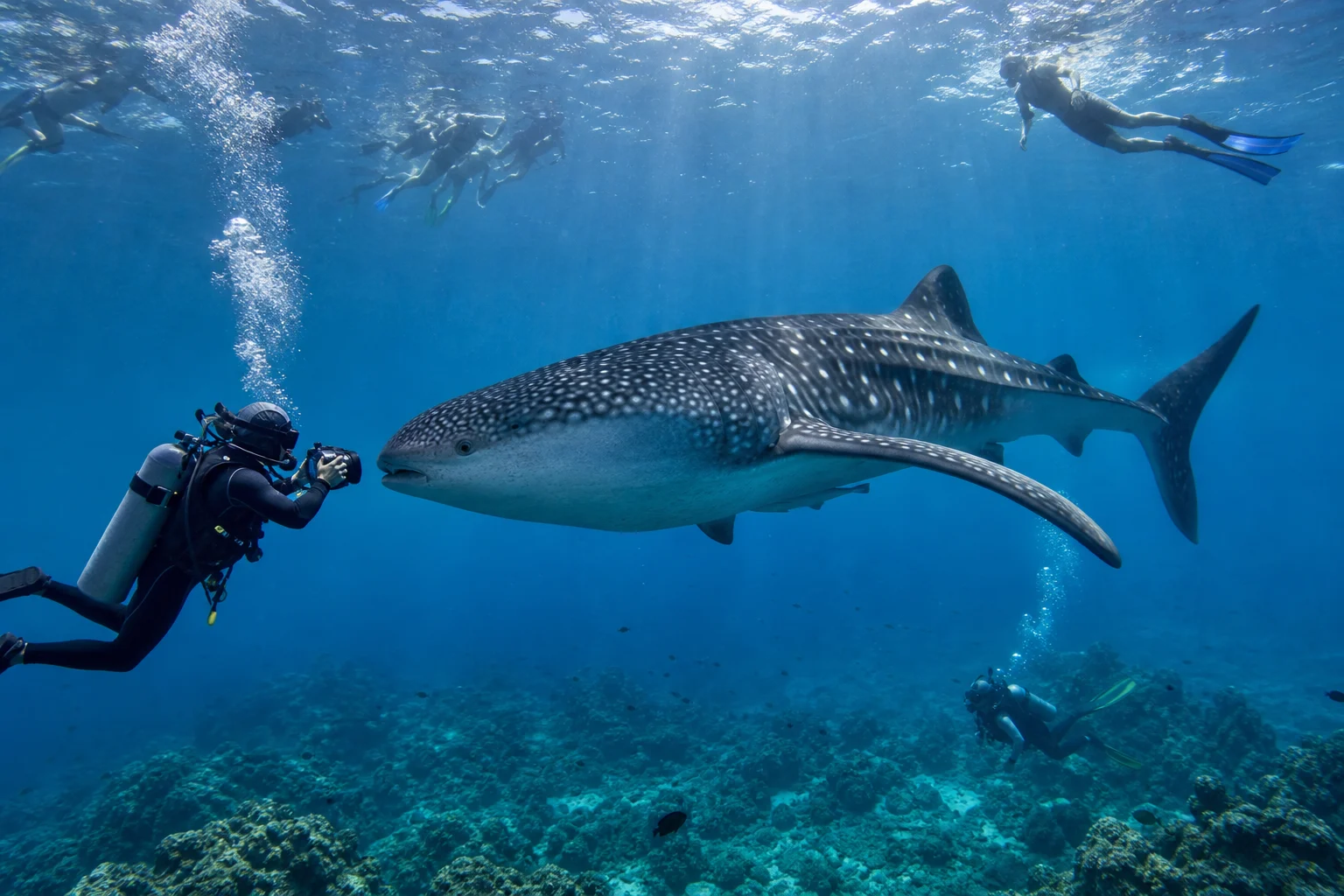
A whale shark moving out of the blue can turn an ordinary day on the water into a lifelong memory. But choosing where to meet the world’s largest fish takes more than picking a destination from a social-media graphic.
Some encounters happen on scuba dives. Others are organized as surface snorkeling excursions, and certain locations prohibit scuba during whale shark interactions. Fishing-related feeding can also change the nature of an encounter. Meanwhile, research and recent trip reports show that a destination’s reputation does not necessarily reflect the chances of seeing a shark today.
Here are nine places worth understanding before planning a trip.
1. Darwin Island, Galápagos, Ecuador: A scuba expedition
For experienced divers seeking whale sharks underwater, Darwin is one of the signature destinations. The Galápagos Science Center describes July through November as a common observation window around Darwin, especially for adult females. Galápagos Shark Diving identifies the cooler middle months of the year as a productive period for whale shark diving.
This is generally a remote dive-liveaboard trip, rather than a casual shore excursion. Ask the operator about required experience, currents, water temperatures and its procedures for keeping divers together. Pick an itinerary for the broader Galápagos experience; even a well-timed voyage cannot promise a whale shark.
2. South Ari Atoll, Maldives: Year-round possibilities
South Ari Marine Protected Area supports a year-round whale shark aggregation, giving travelers more calendar flexibility than many seasonal destinations. Boats search the area for surface encounters, while whale sharks may also be encountered during diving. Confirm the actual format of an excursion before reserving it.
Year-round presence does not mean daily certainty or unlimited access. A Maldivian regulation announced in 2024 strengthened interaction rules, including minimum distances of three metres from the body and four metres from the tail. It prohibits feeding and touching, and restricts disruptive photography and vessel behavior. A responsible operator should explain the current rules before anyone enters the water.
3. Tofo, Mozambique: Combine reef diving with a surface search
Tofo offers a useful combination for divers: reef dives and separate snorkeling ocean safaris. Tofo Scuba says whale sharks are seen in every month, with surface encounters sought during dedicated trips or between dives.
There is a conservation story behind the destination, too. Research summarized by the Marine Megafauna Foundation in 2025 found an 87 percent decline in sightings across surveys conducted from 2005 to 2019. That is a long-term study result, not a measurement of today’s trip success rate. It does mean travelers should ask for recent sighting records rather than rely on Tofo’s historic reputation.
4. Ningaloo Reef, Western Australia: Bring a snorkel
Ningaloo is a well-established destination for guided whale shark swims. Tourism Western Australia identifies March through July as the peak season, with some sharks present outside that window.
The whale shark interaction itself is a snorkeling activity. Western Australian government guidance prohibits scuba equipment during these interactions. Divers can still combine a visit with separate reef diving, but should not assume a “whale shark dive” advertisement means tanks are permitted beside the sharks.
Choose a licensed operator and follow the briefing on approach, swimmer numbers and separation distances. A later tour departure on the calendar is not proof that sharks will still be present.
5. Mafia Island, Tanzania: Surface encounters in Kilindoni Bay
Whale shark excursions off Mafia Island’s southwest coast focus on snorkeling with surface-feeding sharks. Local operator Kitu Kiblu identifies October through March as the typical season of most consistent sightings. Reef scuba diving is a separate part of the island’s appeal.
In a May 2026 report on its 2025 survey season, the Marine Megafauna Foundation reported more sightings per survey trip than in 2024, alongside growing visitor concern about crowding. More sharks do not justify more pressure around each animal. Ask how the operator coordinates with other boats and avoids surrounding a shark.
Treat the whale shark trip as a guided snorkeling excursion. Do not infer an island-wide legal ban on scuba from a simplified destination chart.
6. Donsol, Philippines: Wild encounters without feeding
Donsol’s guided whale shark program is a snorkeling experience, with scuba excluded from the dedicated interaction activity. Its appeal is the opportunity to observe naturally occurring sharks without provisioning.
The municipal tourism office gives a usual season of November to early June and a generally stronger planning window from February through May. Those are planning ranges, not appointment times with wildlife. Register through the official visitor process, attend the briefing and follow the interaction officers’ directions.
WWF-Philippines has promoted Donsol as an alternative to feeding-based whale shark tourism. Choose an operator that respects that distinction.
7. Cenderawasih Bay, Indonesia: Understand the fishing-platform connection
Cenderawasih Bay has year-round whale shark presence and a history of scuba encounters. Many visits focus on traditional bagan fishing platforms, where sharks seek small fish associated with the fishing operation.
Divers Alert Network has documented fish being offered to keep sharks around the platforms. This makes the experience different from searching for free-ranging sharks at an unprovisioned aggregation. Ask specifically whether fish are provided during the visit, how interactions are managed and what current park permissions apply.
Year-round presence also does not remove the logistical demands of a remote trip. Confirm the itinerary and support arrangements rather than assuming every vessel operates throughout the year.
8. Gladden Spit, Belize: A historic hotspot with a major caveat
Gladden Spit is known for snapper spawning aggregations around spring full moons, with whale sharks sometimes arriving to feed on eggs. It should not be described categorically as a snorkeling-only destination: Splash Dive Center currently describes licensed, allocated-time scuba trips.
The stronger caution concerns sightings. Splash reports that its six whale shark trips across April, May and June 2026 produced no whale shark sightings. That is one operator’s record, not a complete reserve-wide census, but it is meaningful information for travelers.
Choose Gladden Spit for the spawning aggregation and wider marine life, with a whale shark as a possible bonus. Confirm current permits, access and recent sightings before booking.
9. Gulf of Tadjoura, Djibouti: A seasonal surface encounter
Djibouti’s national tourism agency places the whale shark observation window between mid-October and late February. Trips commonly focus on surface swimming or snorkeling, often combined with a broader diving holiday.
Confirm whether a package includes a guided whale shark swim, separate reef dives or both. The feeding conditions that bring sharks close to the surface can also affect visibility. Allow flexibility for weather and wildlife movement rather than building the trip around a single guaranteed encounter.
Let the shark set the encounter
Whale sharks are listed as Endangered on the IUCN Red List. Their size should inspire patience, not an attempt to touch, chase, ride or block them for a photograph.
Before booking, ask three practical questions: Is this excursion scuba or snorkeling? What have recent trips actually seen? How does the operator prevent crowding and disturbance?
Follow local separation distances and the guide’s directions, give the shark an unobstructed route and accept that a responsible crew may end an encounter. The best whale shark trip leaves the animal free to continue doing exactly what it was doing before the boat arrived.
Connected reporting
Dive sites and aquatic life in this story
Reporting record