Underwater Archaeology ·
Vis Shipwreck Preserves Hellenistic Hull and Rare Greek Tableware
Excavations in Gnjilna Bay have documented six metres of keel and hull planking alongside Corinth B amphorae, coins, fine ceramics and possible owners’ marks from the fourth or third century BCE.
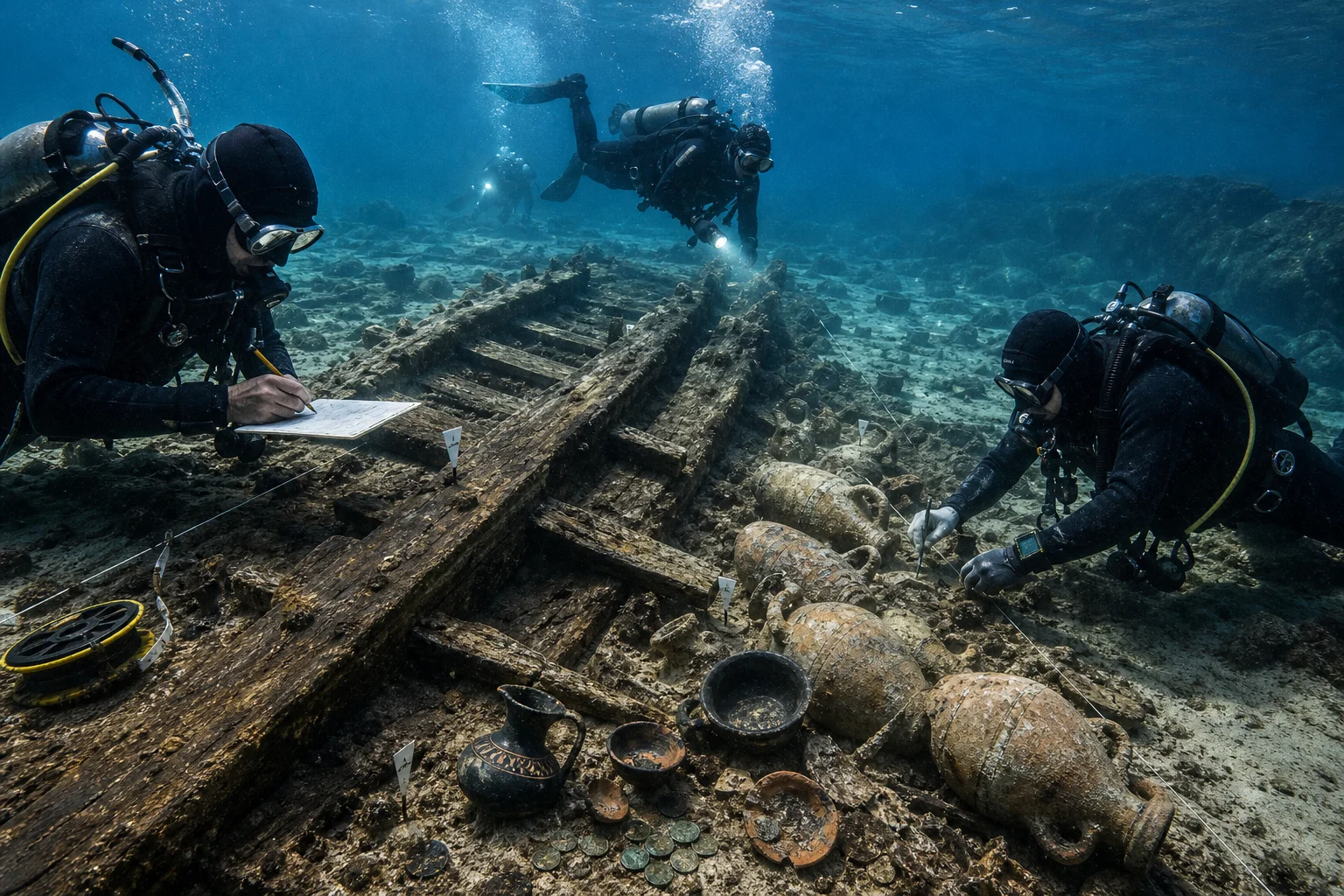
Underwater archaeologists working in Gnjilna Bay near Komiža on the Croatian island of Vis have documented a Hellenistic shipwreck with an unusually informative combination of preserved hull structure, cargo and personal objects.
Research conducted between 2023 and 2025 revealed approximately six metres of wooden keel with attached hull planking. The assemblage also includes shipboard equipment, Corinth B-type transport amphorae, coins from ancient Pharos on neighbouring Hvar, animal bones and fine Greek ceramic vessels. The Croatian Conservation Institute says wrecks carrying Corinth B amphorae are exceptionally rare in Croatian waters and rank among the oldest ancient wrecks known from the eastern Adriatic.
The site is provisionally dated to the fourth or third century BCE from the ceramics and the lead core of a Haldane II A-type anchor crossbar. The fine wares include drinking and serving forms such as a skyphos, askos, aryballos, bowls, plates, salt cellars and a kantharos. Several black-glazed pieces bear marks cut after firing. Researchers interpret these graffiti cautiously as abbreviated personal names, potentially identifying individual ownership aboard the vessel.
The discovery matters because cargo amphorae can reconstruct regional trade, while tableware, food remains and ownership marks offer a more intimate view of daily life at sea. Preserved timbers may also help specialists study ancient eastern-Adriatic ship construction, though the publicly released material does not yet provide a completed dendrochronological or radiocarbon chronology.
The work is led by Jurica Bezak of the Croatian Conservation Institute’s underwater-archaeology department in cooperation with dive centres on Vis. That partnership shows how trained local divers and archaeological authorities can help locate and protect cultural heritage. The announcement does not establish that the excavation area is open to recreational diving, so coordinates, access rules and artifact-protection requirements should be confirmed locally before any visit.
Reporting record