Shipwrecks and Technical Diving ·
Technical Divers Identify Misplaced Channel Wreck as U-672
A 70-metre dive off southwest England has matched a long-misidentified wreck to the German Type VIIC submarine U-672, resolving a wartime position error and showing how field observations can correct the archival record.
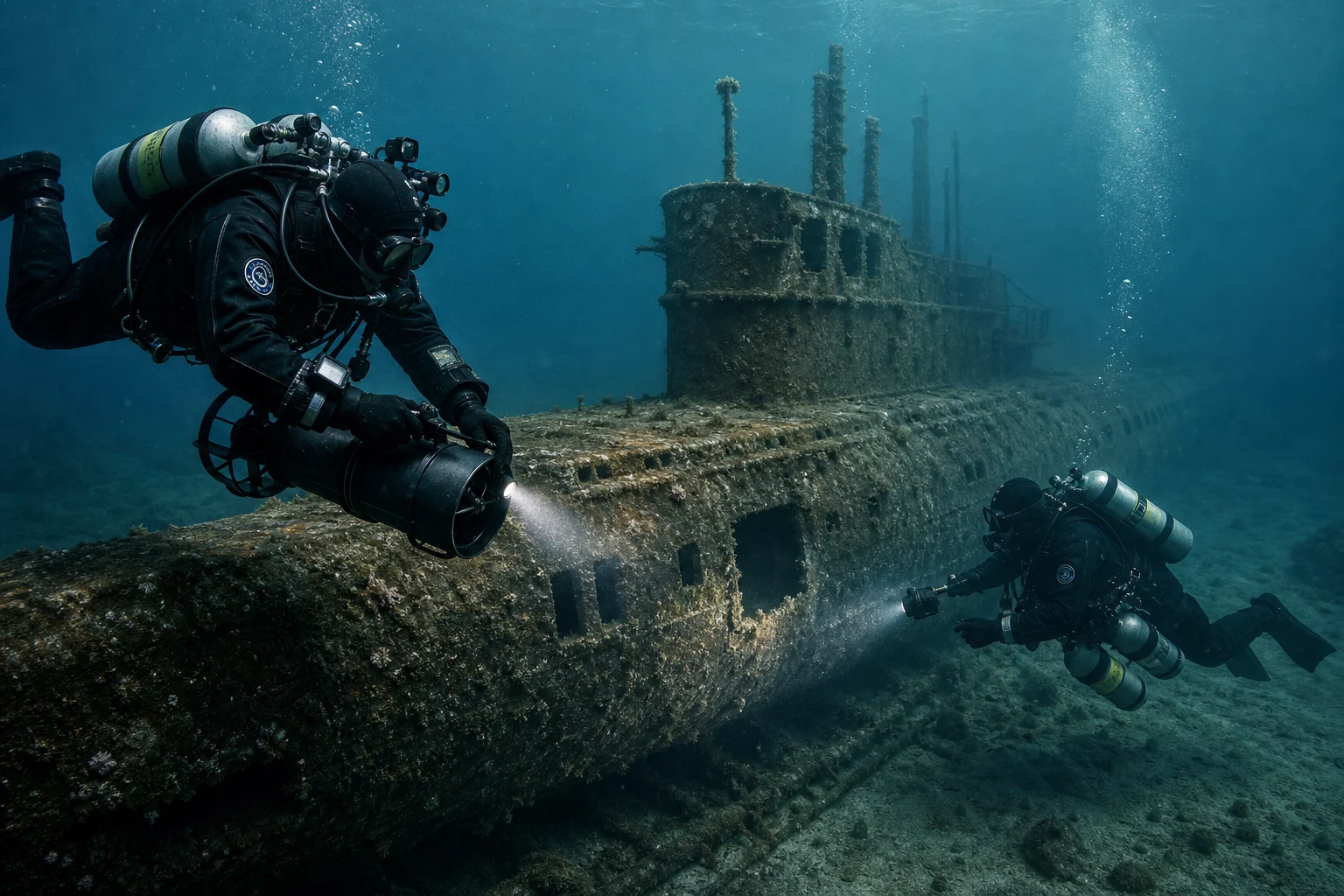
A technical-diving team has identified a submarine wreck in the English Channel as U-672, a German Type VIIC U-boat scuttled in July 1944 after an attack by the Royal Navy frigate HMS Balfour.
The wreck lies at approximately 70 metres and had previously been associated with Hildegard, a First World War-era American sailing vessel. That interpretation began to change on July 25, 2026, when Ian Taylor’s Skin Deeper and Portland Gas Shack team dived the site and recognized that the remains were a submarine.
A follow-up expedition by the Gasperados technical-diving team set out to narrow the identification. Divers Dom Robinson and Guy Trees reached the wreck after an earlier attempt was defeated by conditions. Using diver propulsion vehicles, they had roughly 20 minutes of bottom time to examine the submarine’s external features before beginning a long decompression schedule.
Their observations included an early ball-float snorkel arrangement, the absence of a later rescue-dinghy container, three rectangular openings in the outer casing and cylinders associated with the Aphrodite radar-decoy system. Photographs and video were shared with German U-boat historian Axel Niestlé, who supported the identification as U-672.
The location also fits earlier archival work by maritime historian Innes McCartney. He had proposed that digits in the recorded loss position were transposed, moving the expected site substantially west of the official wartime position. The location where U-672’s crew was recovered offered a further consistency check.
U-672 was attacked on July 18, 1944, during its fourth patrol. After sustaining damage, the submarine surfaced under cover of darkness and was scuttled after its crew escaped. All 52 people aboard survived and became prisoners of war, so the wreck is not known to contain wartime fatalities.
For divers, the identification is more than a new name on a chart. It demonstrates how technical diving, propulsion systems, digital imaging and careful feature-by-feature comparison can test historical records at depth. The site remains an advanced expedition objective: about 70 metres is well beyond recreational limits, with short bottom time, current, decompression and offshore logistics all demanding specialist training and planning.
Reporting record