Future Artificial Reefs ·
SS United States Reefing Awaits Final Federal Approval
Environmental preparation is complete, but Okaloosa County has not set a sinking date while final federal approvals remain pending.
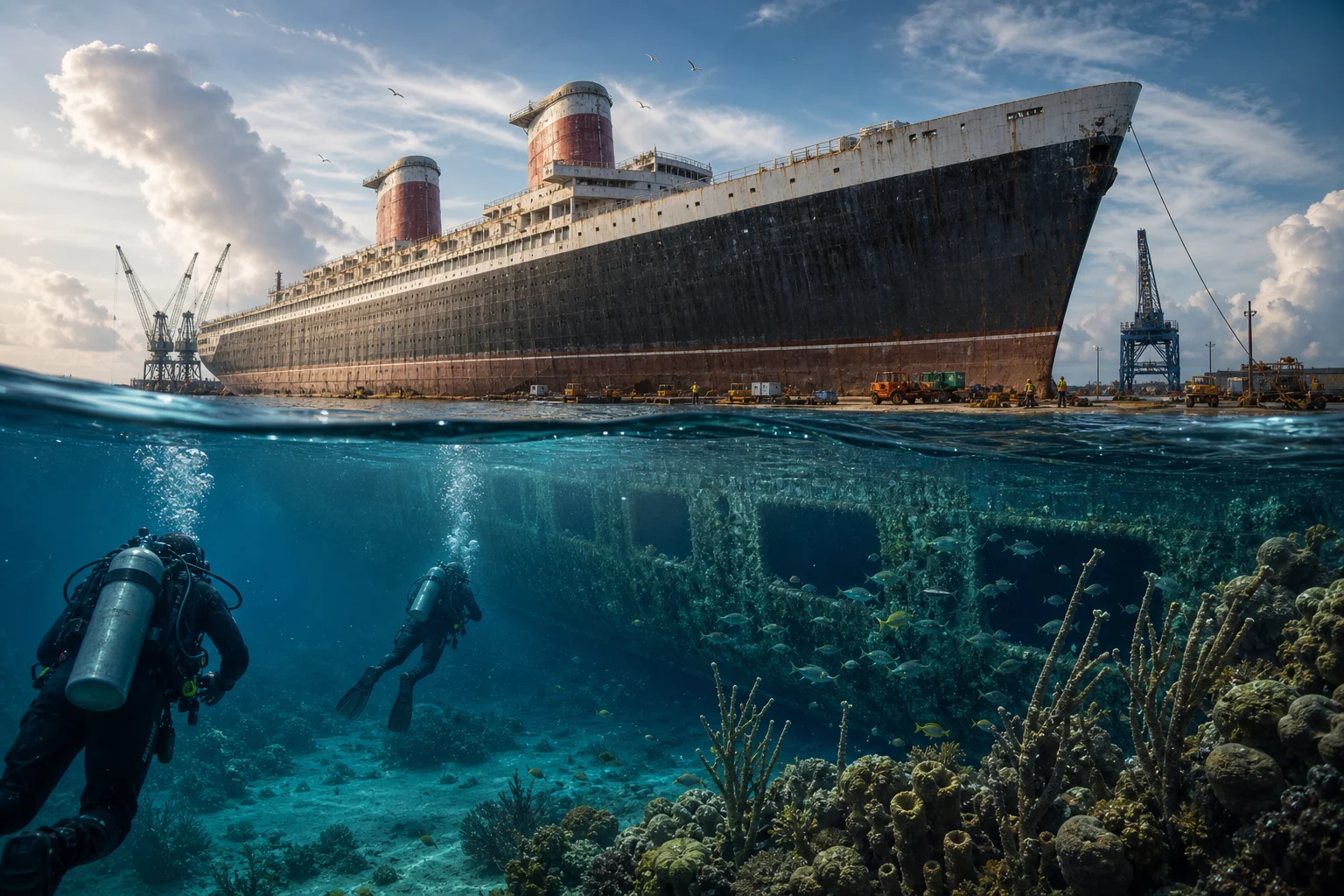
The conversion of SS United States into a Gulf of Mexico artificial reef has reached an important holding point: the vessel’s environmental preparation is complete, but its deployment has not been scheduled.
Axios reported on August 26 that Okaloosa County is waiting for final approval from the U.S. Army Corps of Engineers. The county’s own project FAQ also says a date cannot be set until final approvals are received from both the Corps and the U.S. Environmental Protection Agency.
That distinction matters because earlier project coverage placed the sinking in early 2026. As of the latest public update, that timetable is no longer current. The 990-foot ocean liner remains in Mobile, Alabama, and there is no announced tow or deployment date.
Okaloosa County says the required environmental remediation has been completed after more than a year of work. The preparation followed federal and interstate guidance for vessels intended as artificial reefs, including removal of potentially harmful materials and alterations intended to help the ship descend and provide openings for marine life. Axios likewise reported that potentially harmful materials and pollutants had been stripped from the vessel.
The proposed reef site is about 20 nautical miles south of Destin-Fort Walton Beach. The county describes a planned bottom depth of approximately 180 feet, with the upper deck around 55 feet. Those figures suggest a site with features spanning recreational and technical depth ranges, but they are still proposed parameters. The exact coordinates have not been published, and the final orientation, minimum clearance, mooring configuration and post-deployment access guidance cannot be known until after the sinking and survey.
For divers, the scale is extraordinary. SS United States remains the largest passenger ship built in the United States and still holds the transatlantic speed record associated with its 1952 maiden voyage. If successfully deployed, its long hull and multiple depth levels could become a major Gulf Coast wreck-diving destination and a large new substrate for marine colonization.
Scale does not make the eventual site automatically suitable for every diver. Offshore conditions, boat logistics, current, visibility, overhead hazards, entanglement risks and the depth of a chosen route will determine the training and experience required. No one should plan a dive from preliminary renderings or pre-sinking deck arrangements.
The practical update is therefore straightforward: SS United States remains a future artificial reef, environmental preparation is reported complete, federal approval is still pending, and no sinking date has been set. The next meaningful milestones will be final permits, a public deployment notice, confirmed coordinates, the vessel’s actual resting attitude and an official post-sinking survey.
Connected reporting
Dive sites and aquatic life in this story
Reporting record