Artificial Reefs ·
SS United States Reef Deployment Scheduled for Second Week of November
Okaloosa County says the historic 990-foot ocean liner is scheduled for weather-dependent deployment about 22 nautical miles southwest of Destin-Fort Walton Beach, advancing a project intended to create the world’s largest artificial reef.
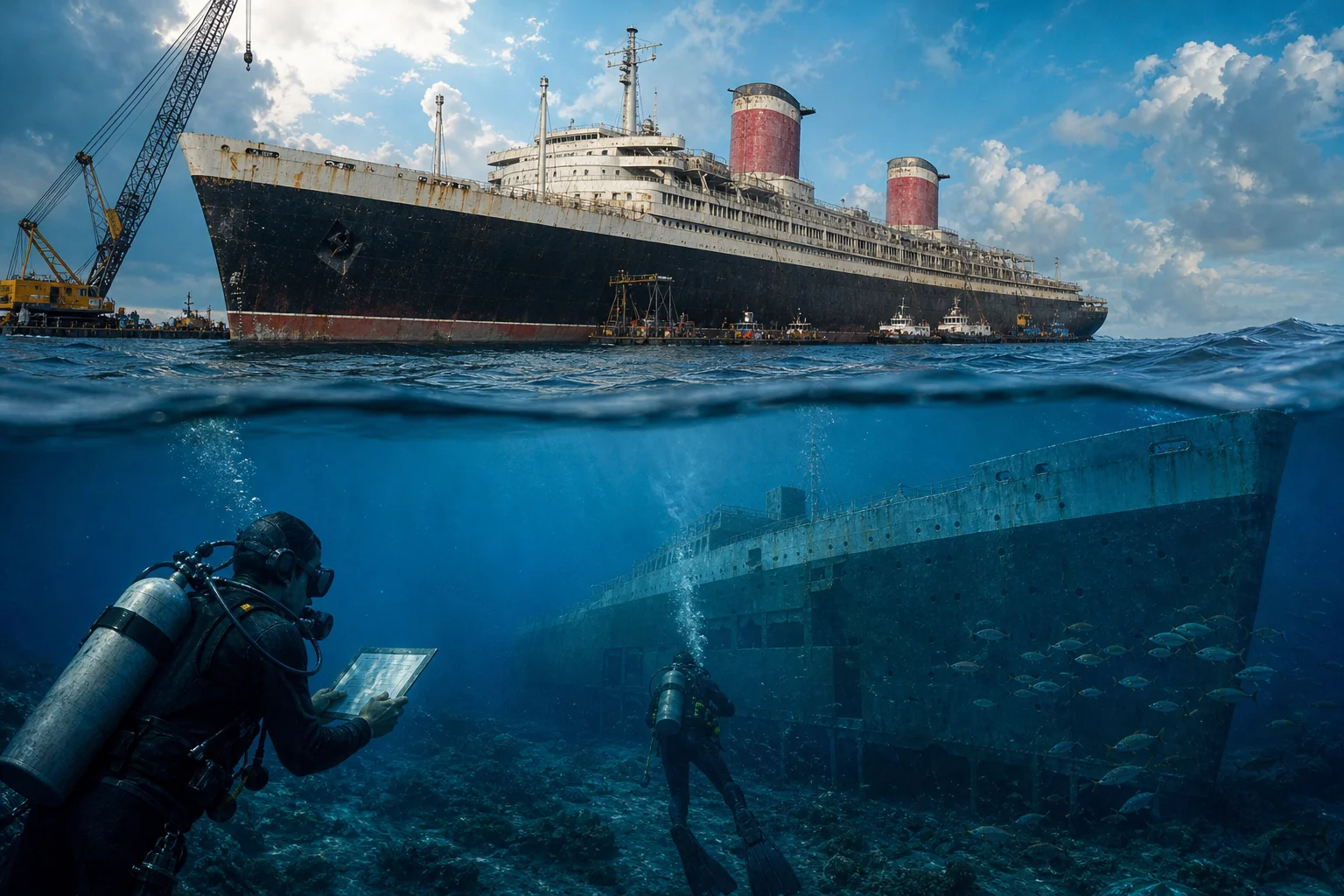
Okaloosa County has announced a new deployment window for the SS United States, saying the former ocean liner is scheduled to be placed on the Gulf seabed during the second week of November 2026.
The county said the operation will take place about 22 nautical miles southwest of Destin-Fort Walton Beach. It emphasized that the schedule is weather-dependent and may change, while additional deployment details will be released in the coming weeks. County officials also said they are coordinating with safety and security partners for the operation.
The announcement is the most specific timetable yet for a project that has experienced repeated delays during environmental remediation, engineering work and permitting. The vessel has remained in Mobile, Alabama, while contractors prepared it for intentional sinking. Earlier reporting said the work included removing fuel, wiring, glass, plastics and other materials, as well as making structural modifications intended to support a controlled deployment.
At 990 feet long, the SS United States would be larger than any vessel previously deployed as an artificial reef. Okaloosa County’s selected site is approximately 180 feet deep, with earlier project plans indicating that the ship’s upper structure could lie about 60 feet below the surface. Those figures remain planning estimates until a post-deployment survey confirms the vessel’s final position, orientation and clearances.
For divers, the ship could eventually offer an unusually large wreck with zones spanning recreational, advanced and technical depths. That scale should not be confused with immediate access. The site should not be treated as open until local authorities complete inspection, publish final coordinates and restrictions, and provide guidance about navigation, moorings and vessel traffic. Any interior route would be an overhead environment requiring suitable wreck-penetration training, equipment and planning.
The project also carries exceptional maritime-history significance. Built in 1951 and placed in service the following year, the SS United States set the transatlantic speed record on its maiden voyage and retained the Blue Riband. Its conversion has remained controversial among preservation advocates, while county officials have argued that reefing preserves the ship’s identity and creates habitat, fishing and tourism value.
The November window is therefore a major milestone, but not the final one. Weather, towing conditions and operational requirements could still move the date. Confirmation of the actual deployment, seabed survey results and formal opening information will determine when the ship can be listed as an active dive site.
Connected reporting
Dive sites and aquatic life in this story
Reporting record