Artificial Reefs ·
South Carolina Adds a Trawler and Tests New Concrete Towers on Offshore Reefs
A retired 65-foot trawler now rests on the C.J. Davidson Jr. Reef, while eight experimental concrete towers at Charleston 60' Reef will be monitored as possible models for future habitat projects.
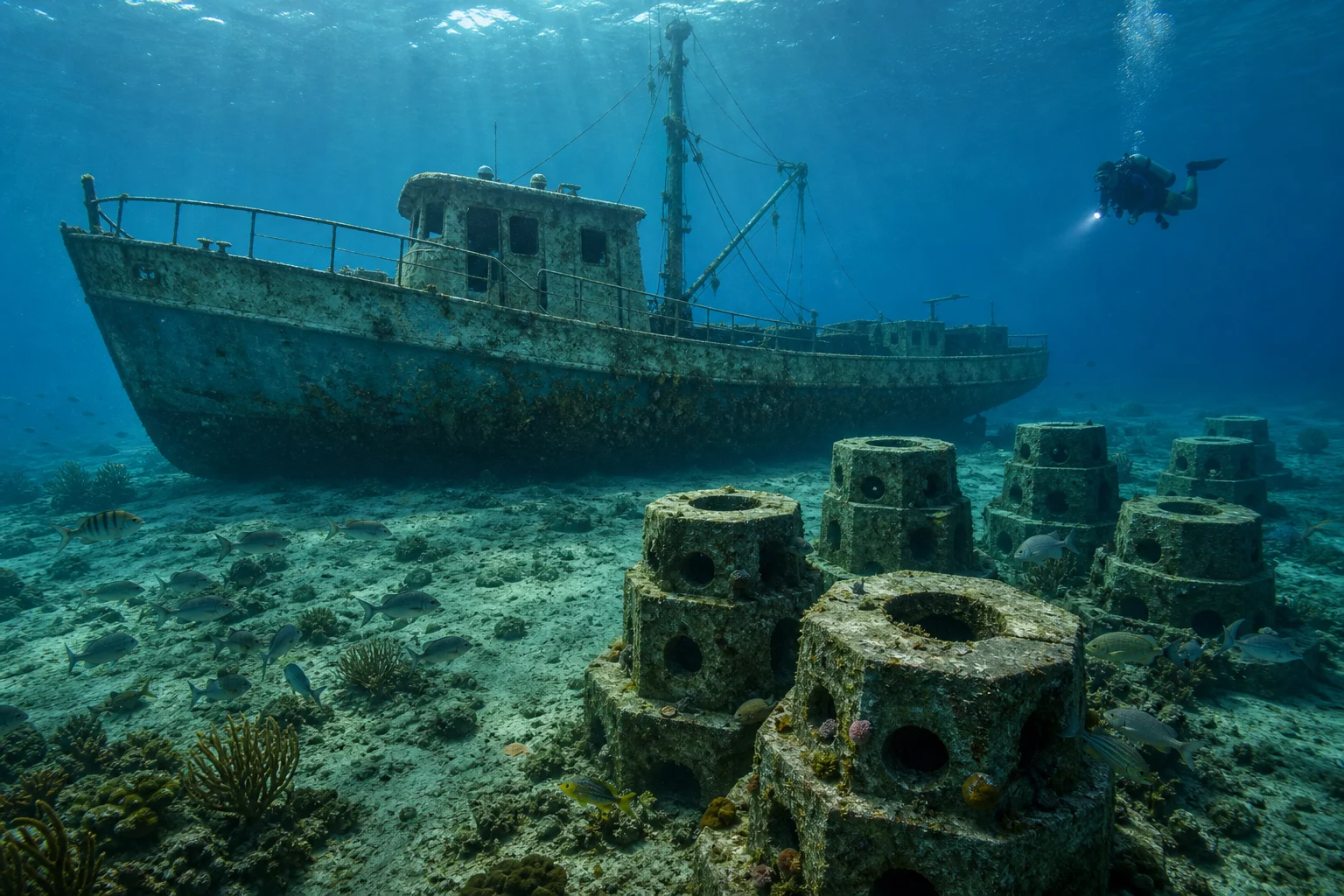
South Carolina has expanded two of its established offshore artificial reefs with very different kinds of structure: a retired commercial vessel off Georgetown and experimental concrete towers off Charleston.
At the C.J. Davidson Jr. Reef, designated PA-16, South Carolina Department of Natural Resources staff deployed a 65-foot retired trawler in approximately 50 feet of water. The vessel joins a large barge and 20 former Army vehicles already on the site. The latest deployment received support from Sea Hunt Boat Company and Coastal Conservation Association South Carolina, whose partnership has helped fund 14 reef projects.
Farther south, SCDNR biologists placed eight experimental towers at the Charleston 60' Reef, PA-24. The towers were assembled from octagonal concrete units originally developed for erosion-control work and configured in several heights and arrangements. According to artificial reef program leader Robert Martore, the agency plans to monitor whether the structures attract and retain significant numbers of fish before deciding whether to build and distribute more of them along the coast.
The paired projects illustrate two approaches to reef development. Prepared vessels can add large, recognizable relief to an existing site, while repeatable concrete designs give managers a way to test habitat shapes and potentially scale successful configurations. SCDNR says reef material is cleaned and prepared before deployment, and that new structures commonly take about six months to become colonized enough to function as fish habitat.
For divers, the trawler could become a notable new feature at a reef already lying in recreational-depth water, but the announcement is not a dive briefing. Exact coordinates, the vessel's orientation, its highest point, structural condition and any penetration hazards should be confirmed through SCDNR and local operators before a Dive Site record is published. The Charleston towers are also best treated initially as a monitored habitat experiment rather than a newly promoted dive attraction.
The strongest follow-up will come from SCDNR's monitoring: whether the concrete tower designs differ in fish use, fouling-community growth or durability, and whether the agency chooses to replicate them elsewhere. Those results could make this more than a deployment notice by showing which modular forms actually perform well in South Carolina waters.
Connected reporting
Dive sites and aquatic life in this story
Reporting record