Marine Conservation ·
South Australia Bloom Report Documents at Least 8,255 Shark and Ray Deaths
A citizen-science analysis records 31 elasmobranch species affected during the 2025–26 harmful algal bloom, with bottom-dwelling sharks and rays accounting for most documented losses.
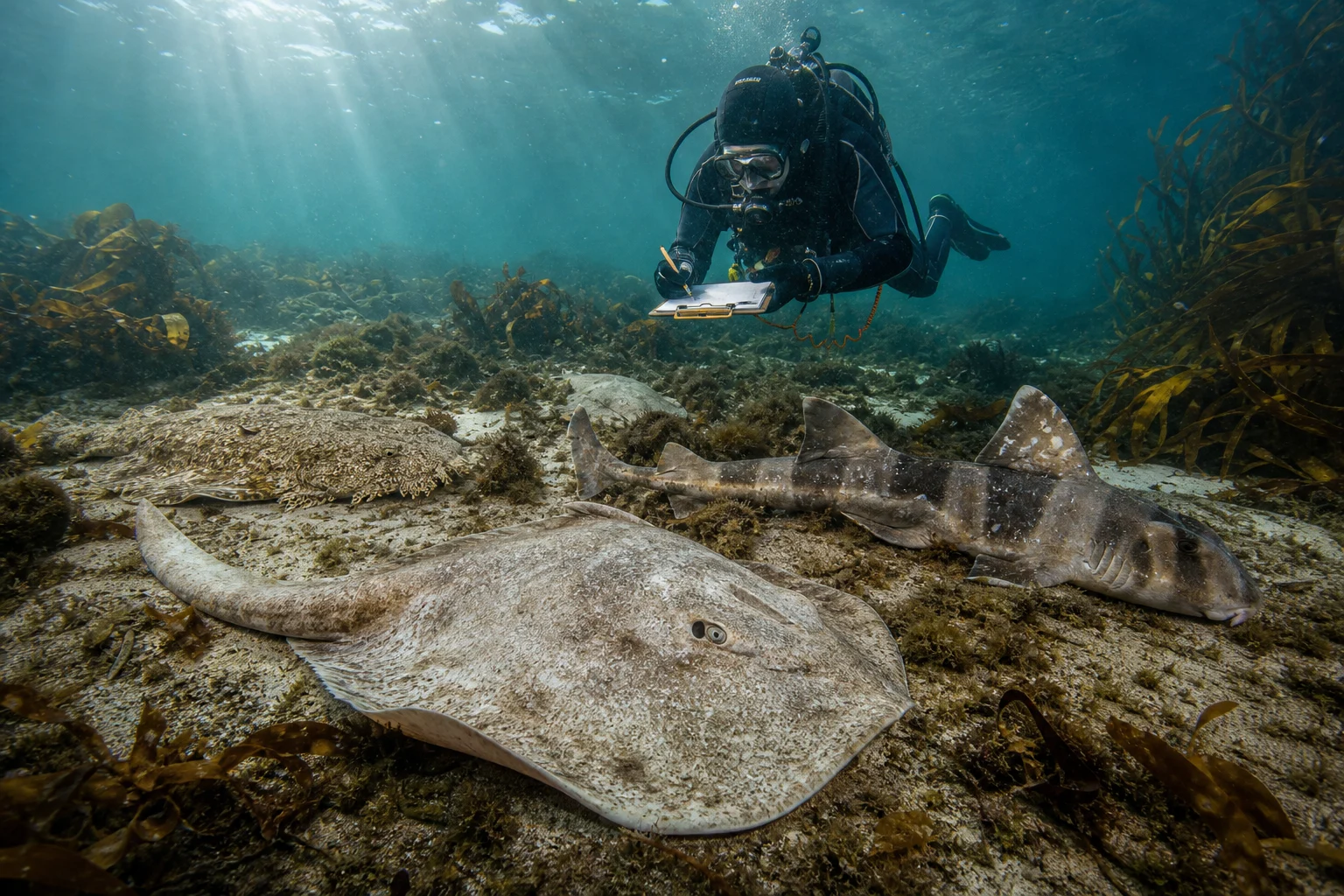
A new public report has documented approximately 8,255 shark, ray, skate and stingaree deaths in South Australian waters affected by the prolonged 2025–26 harmful algal bloom. The authors stress that this is a conservative recorded minimum rather than a complete population-loss estimate.
The analysis combines 4,787 iNaturalist records submitted by 683 community observers with counts from National Parks and Wildlife Service rangers on Kangaroo Island, PIRSA Fishwatch reports and government beach-cleanup teams. Researchers checked species identifications, counted animals shown in photographs and descriptions, removed known duplicates and excluded records indicating fishing-related mortality.
Thirty-one species appear in the combined dataset. Southern fiddler rays accounted for at least 4,457 documented deaths, followed by 852 Port Jackson sharks, 672 cobbler wobbegongs and 649 western shovelnose rays. The report says benthic, site-associated sharks and rays made up 96% of the recorded mortality, including animals from local populations that may recover slowly because many sharks and rays mature late and produce relatively few young.
The numbers do not prove that a stated percentage of any species’ total population was lost. Offshore deaths, remote shorelines and unrecorded carcasses mean the count is incomplete, while baseline abundance is poorly known for several affected species. Nevertheless, the combination of mass wash-ups, acoustic tracking, fisheries information and in-water observations indicates severe local depletion in some previously occupied areas. Two narrow-range South Australian endemics—the coastal stingaree and pygmy thornback skate—were among the recorded mortalities.
Divers have a meaningful role in what comes next. The report says diving and snorkelling surveys have found few or no benthic sharks and rays at some formerly productive locations. Repeat observations, fixed-point photography and carefully georeferenced sightings can help distinguish recolonization from continuing absence, while also documenting damage to seagrass, macroalgae and other prey-producing habitats. Any monitoring should follow current health guidance, avoid handling carcasses and use established reporting channels.
Recovery time remains unknown. The report calls for sustained population assessment, habitat monitoring, toxin research and conservation planning rather than assuming that lower bloom concentrations mean the ecosystem has returned to its former condition.
Reporting record