Artificial Reefs ·
North Carolina Advances Plan to Reef R/V Cape Hatteras
A state solicitation seeks a contractor to prepare and sink the 134-foot research vessel at artificial reef AR-386, but the vessel’s donation still awaits a Cape Fear Community College board decision.
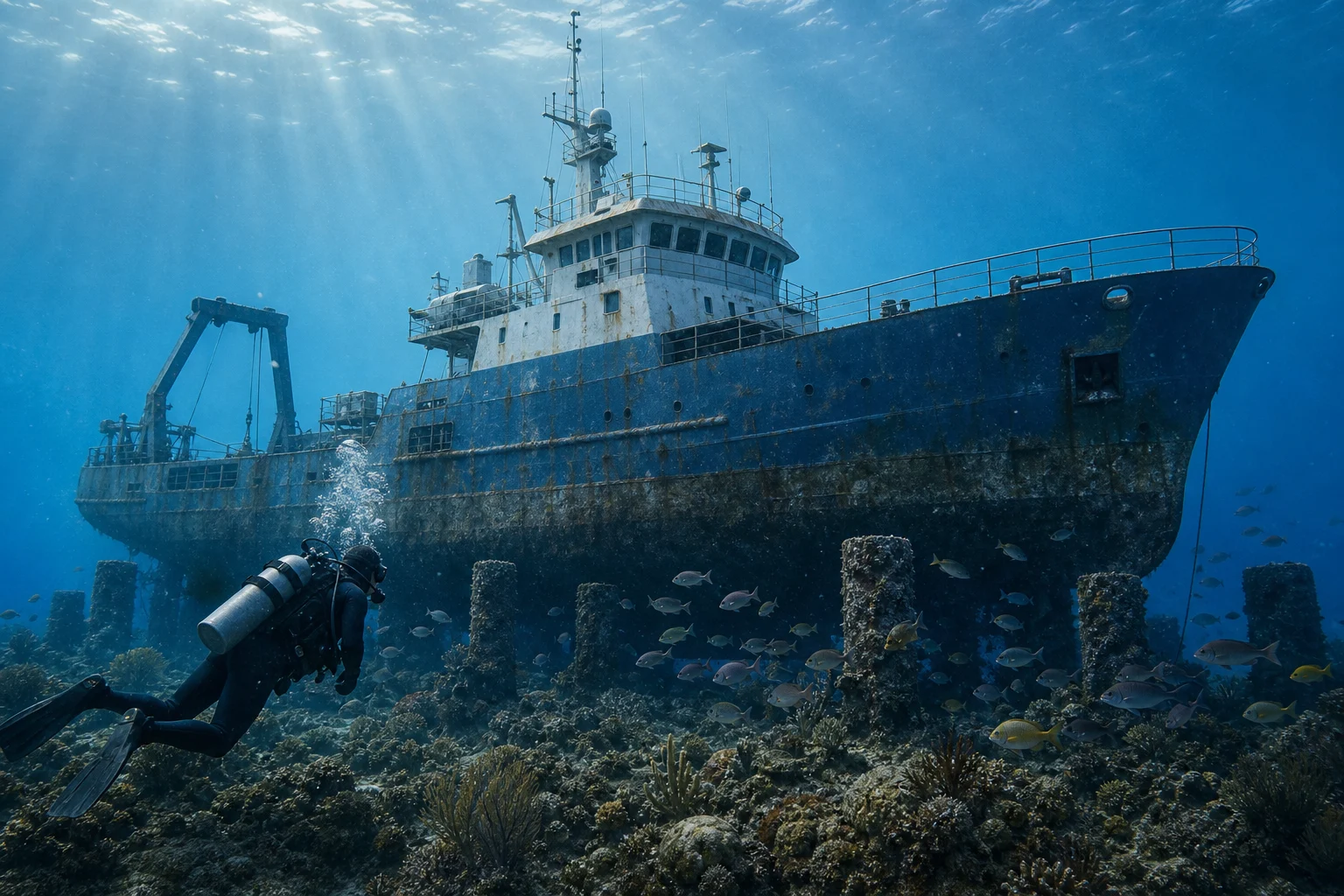
North Carolina is moving toward converting the research vessel R/V Cape Hatteras into an offshore artificial reef, although a final transfer of the ship has not yet been approved.
An Invitation to Bid issued by the North Carolina Department of Environmental Quality’s Division of Marine Fisheries calls for a contractor to accept the steel vessel at a shipyard, remove or secure materials that could threaten navigation or the environment, tow it offshore and sink it at the existing AR-386 reef site. The document describes the vessel as approximately 134 feet long, 32 feet wide and about 640 long tons displacement.
The proposed placement area is in roughly 78 feet of water near 33°57.517′ N, 77°33.400′ W. The specifications require at least 15 feet of vertical clearance above the completed reef and anticipate removing about 10 feet of superstructure to achieve that clearance. The final position would be selected within 1,500 feet of the reference coordinate, so the point in the solicitation should not be treated as a confirmed wreck location.
The contract schedule calls for the vessel to be prepared and deployed by June 30, 2027, subject to award, approvals, remediation and workable sea conditions. Cape Fear Community College separately posted notice that its Board of Trustees intends to consider donating the vessel to the state at a November 19, 2026 meeting. That means the reef project remains conditional; the college has not yet announced final approval of the transfer.
Built in 1981, Cape Hatteras served as a research platform for Duke University and the National Science Foundation before Cape Fear Community College acquired it in 2013 for marine-technology education. If the project proceeds, the ship could become a substantial new structure within an established North Carolina reef area.
For divers, the proposed depth suggests a site that may eventually fall within advanced recreational profiles, but no dive plan should be made from the procurement documents. Final orientation, least depth, mooring arrangements, coordinates, structural openings and access guidance will need to come from post-deployment surveys and the reef program.
Reporting record