Artificial Reefs / Conservation ·
Mexico Approves a 700-Module Memorial Reef off Cancún
The MARE Santuario del Mar project would place concrete Reef Ball modules containing memorials made with cremated remains in three shallow-water zones between Cancún and Isla Mujeres, creating an unusual new artificial-reef complex.
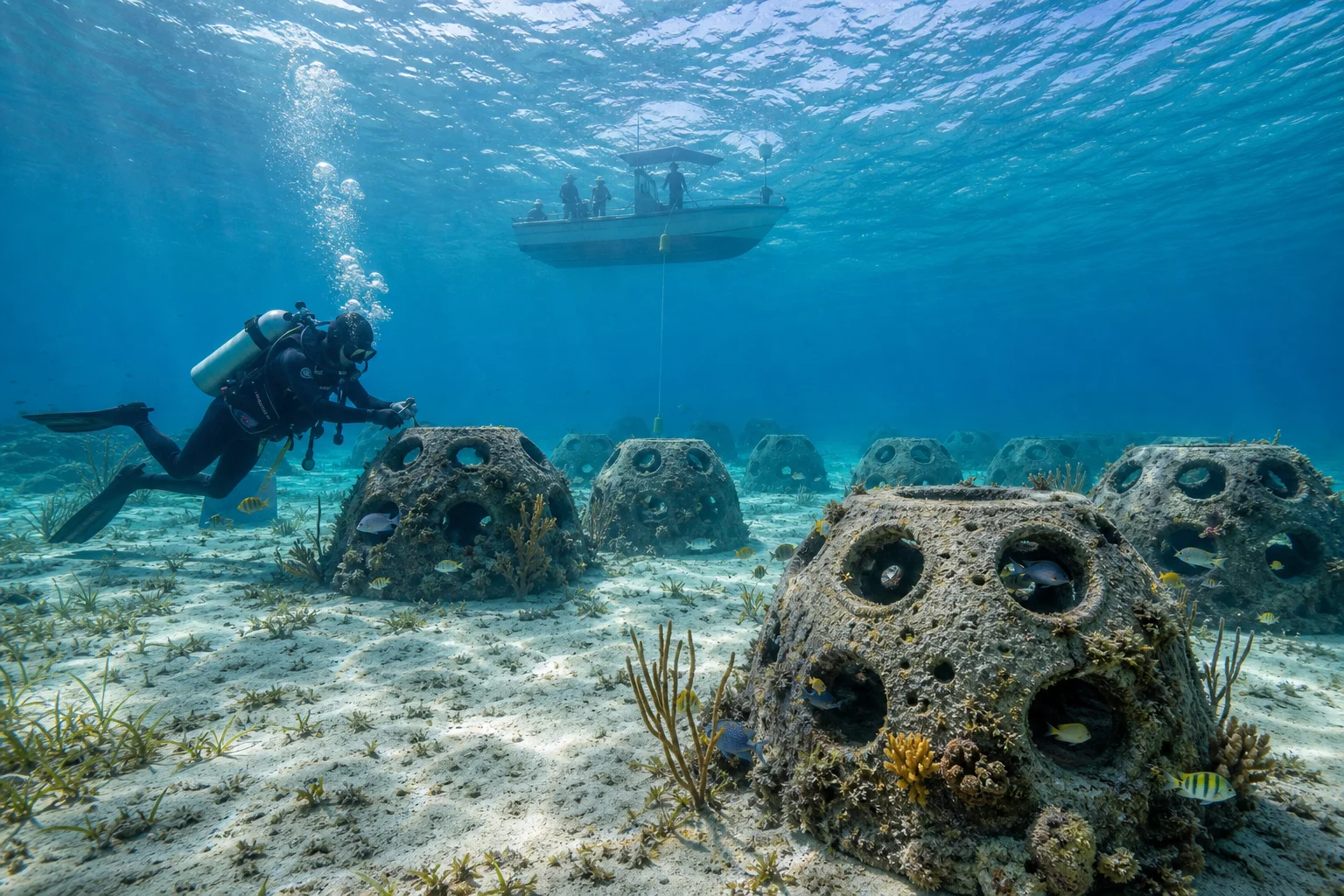
Mexico’s federal environmental authority has approved an unusual artificial-reef project off Cancún that combines marine habitat construction with memorial services.
MARE Santuario del Mar is planned for the Bahía de Mujeres area between Cancún and Isla Mujeres. The project calls for the gradual installation of 700 Mini Bay Ball concrete reef modules across three marine polygons totaling about 34 hectares. The individual structures would occupy only a small portion of that area and are intended to be placed on sandy seabed while avoiding seagrass and other sensitive habitat.
Each module can receive a “Memorial Pearl” made from marine concrete mixed with cremated human remains. Families would be able to participate from a vessel while trained divers handle the underwater placement. The plan anticipates a staged installation over approximately seven years rather than a single mass deployment.
At a reported maximum depth of about three metres, the reef would be much shallower than a conventional scuba wreck. Its most immediate diving connection is the professional dive work required to place and inspect the modules, although the clear, shallow setting could eventually create interest for snorkellers and freedivers if public access is authorized. Approval of the environmental-impact assessment should not be read as confirmation that unrestricted recreational access, navigation arrangements or operating procedures have been finalized.
The project’s ecological case rests on adding hard, textured habitat to otherwise sandy bottom. The hollow, porous modules are designed to provide shelter for fish and attachment surfaces for algae, sponges and corals. Project documents also describe measures intended to protect submerged vegetation, including placement outside seagrass beds.
For the diving community, MARE Santuario del Mar is significant less as a conventional dive attraction than as a test of how artificial reefs, memorial practices and coastal habitat restoration can overlap. Long-term value will depend on careful siting, transparent monitoring and evidence that the modules develop biological communities without harming nearby seagrass or interfering with navigation.
Connected reporting
Dive sites and aquatic life in this story
Reporting record