Deep-Sea Exploration and Marine Life ·
MBARI Records First 4K Footage of Rare Transparent-Headed Barreleye
The 20-minute ROV encounter at approximately 600 metres was only MBARI’s eleventh sighting of Macropinna microstoma in nearly four decades of deep-sea exploration.
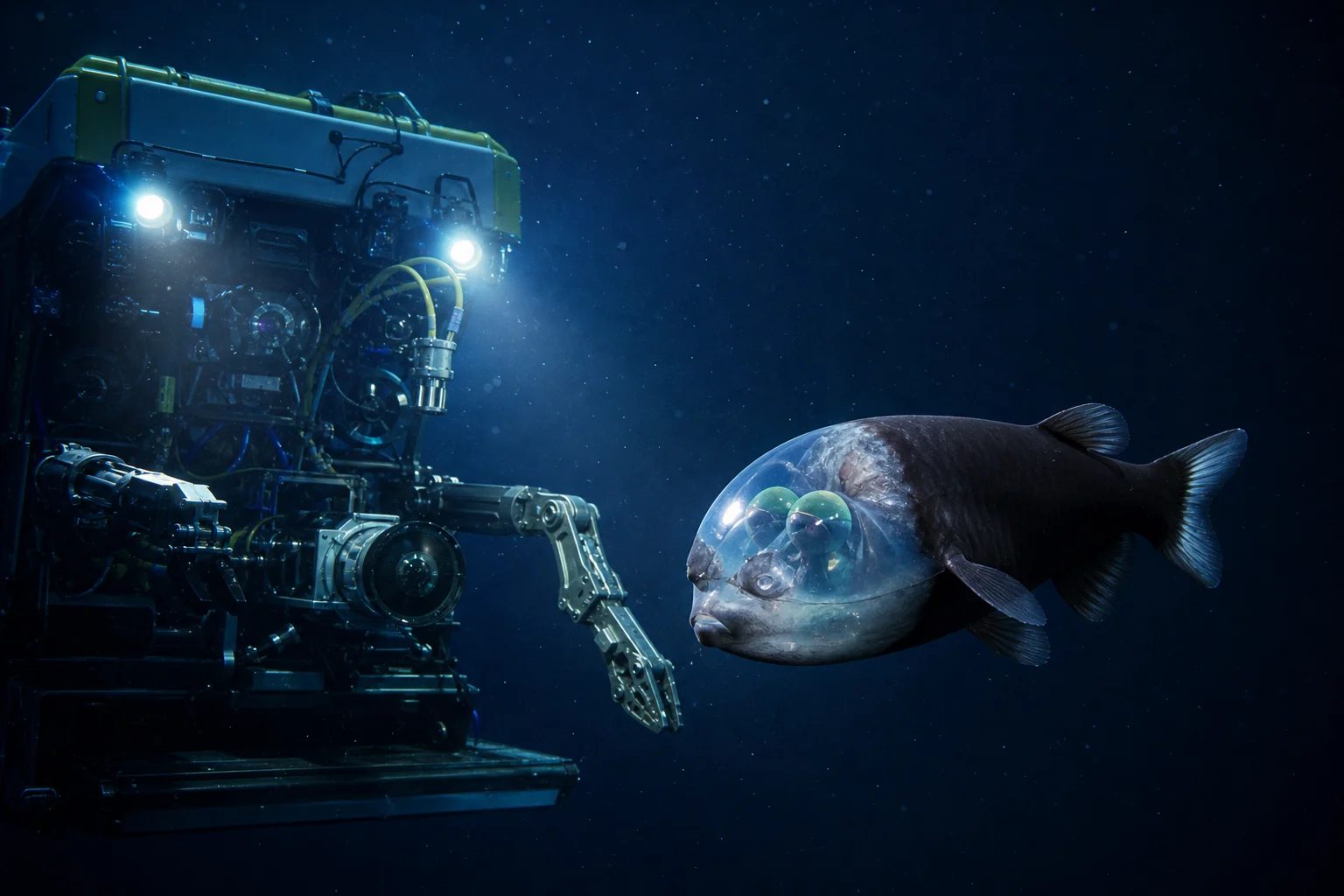
Scientists with the Monterey Bay Aquarium Research Institute have recorded their first 4K footage of the rarely observed barreleye fish Macropinna microstoma, capturing detailed views of the animal’s transparent head and unusual visual system.
The encounter occurred during MBARI’s eight-day Diving Deep for Delicate Drifters expedition aboard the research vessel David Packard. Researchers were working roughly 90 kilometres offshore with the remotely operated vehicle Doc Ricketts when a team member spotted the fish during the vehicle’s return toward the surface.
The barreleye was swimming at approximately 600 metres, well within the ocean’s twilight zone and far beyond scuba range. The team observed it for about 20 minutes, adjusting lighting and camera positions to document its body and behaviour. A stereo VR camera also captured three-dimensional imagery intended to support future research, education and public interpretation.
Macropinna is immediately recognizable for the clear, fluid-filled shield covering the top of its head. Beneath that dome, tubular eyes can rotate from an upward-looking position to face forward. The arrangement allows the fish to scan the faintly lit water above for prey and then keep a target in view while feeding. The shield may also protect its eyes when it takes small crustaceans from among the stinging tentacles of siphonophores.
MBARI did not collect the animal. Researchers expect the close-up footage to help them study the fish’s visual adaptations, including pigments in its eye lenses that may improve the detection of subtle optical cues in dim midwater conditions.
The sighting was exceptionally uncommon even for a major deep-sea research programme. Across nearly 7,000 ROV dives and more than 41,000 hours of recorded deep-sea video, MBARI has encountered Macropinna only 11 times. Its previous observation was in 2021. This was the first sighting recorded in 4K and the first made from the institute’s new flagship vessel.
Although the barreleye itself was found by an ROV, the wider expedition combined robotic surveys with blue-water scientific scuba near the surface. That paired approach lets researchers examine delicate midwater animals across depths that cannot be covered by any single method.
For the diving community, the footage is a reminder that underwater exploration extends far beyond accessible reefs and wrecks. It also demonstrates how high-resolution cameras, careful vehicle piloting and non-collection observation can reveal behaviour without removing a rare animal from its environment.
Connected reporting
Dive sites and aquatic life in this story
Reporting record