Underwater Archaeology ·
Kekova Amphora Site Claimed as World’s Oldest Known Shipwreck
Underwater archaeologists near Türkiye’s Kekova Island are excavating an Early Bronze Age cargo assemblage dated to roughly 2600–2400 BCE, although the vessel’s wooden structure has not survived and the record-setting claim requires scholarly review.
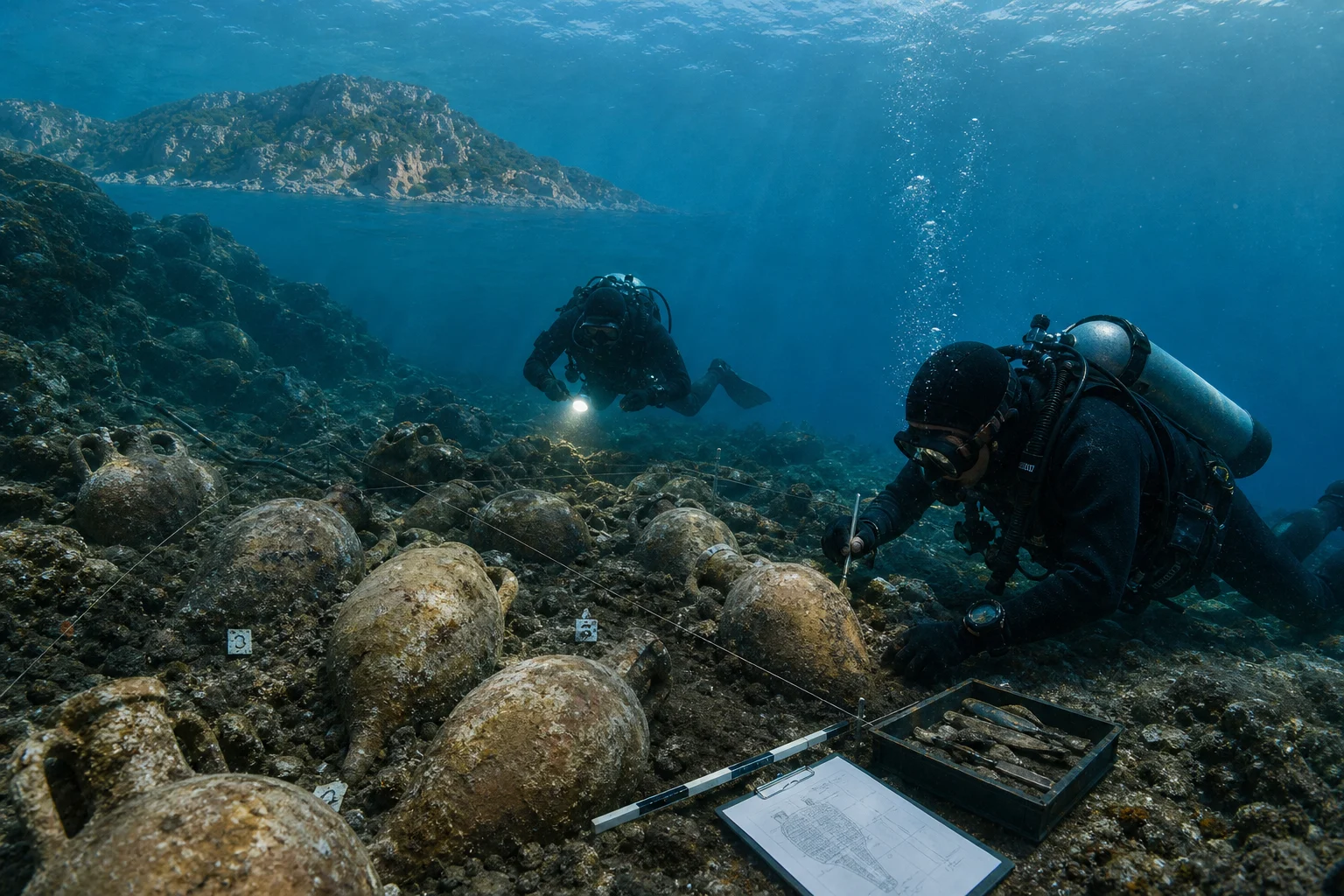
Underwater excavations near Kekova Island in southern Türkiye have exposed an Early Bronze Age cargo assemblage that the country’s culture minister has described as traces of the world’s oldest known shipwreck.
The site is being investigated under permits from Türkiye’s Ministry of Culture and Tourism, with the 2026 excavation led through the Antalya Museum Directorate by underwater archaeologist Hakan Öniz and a team associated with Akdeniz University. The wreck area had been identified during earlier surveys, but researchers initially underestimated the age of the visible ceramics.
Clay analysis and comparisons with excavated pottery elsewhere place the amphorae approximately 4,400 to 4,700 years ago, around 2600–2400 BCE. The jars resemble types produced in the Jordan Valley and examples found in Egypt, Troy and Crete. Researchers therefore propose that the vessel originated on the Levantine coast and was sailing toward Troy or Crete when it was lost.
The wooden hull has not survived, which makes the site more accurately a wreck-associated cargo assemblage than an intact ship. Its identity and age rest on the archaeological context, pottery typology and material analysis rather than surviving timbers that could be directly dated. That distinction matters when comparing the site with the approximately 4,200-year-old Dokos cargo site in Greece and other contenders for the oldest known shipwreck.
The recovered storage vessels are thought to have carried products such as olive oil or wine. One modified amphora bears nine marks and two holes; investigators have proposed that it may have served as a churn for butter or cheese. The intriguing suggestion that sailors might have processed dairy products aboard ship remains an interpretation, not a demonstrated account of shipboard life.
For divers, the discovery is an exceptional example of scientific diving supporting maritime archaeology at a depth of roughly 30 metres. Work at that depth still demands disciplined excavation, documentation, conservation planning and controlled ascent profiles. The site is protected archaeological terrain—not a recreational wreck attraction—and its exact location and access should not be promoted without authorization.
Further publication of the dating evidence, artifact catalogue and excavation context will determine how securely the site can claim the world-age record. Even without that superlative, it provides rare evidence of long-distance seafaring and exchange in the eastern Mediterranean during the Early Bronze Age.
Reporting record