Scientific Diving ·
Florida Keys Coral Shades Reduce Bleaching in Diver-Monitored Trial
Temporary structures that cut light by 60% reduced color loss in two brain-coral species during a hot Florida Keys summer, offering a targeted intervention rather than a scalable substitute for climate action.
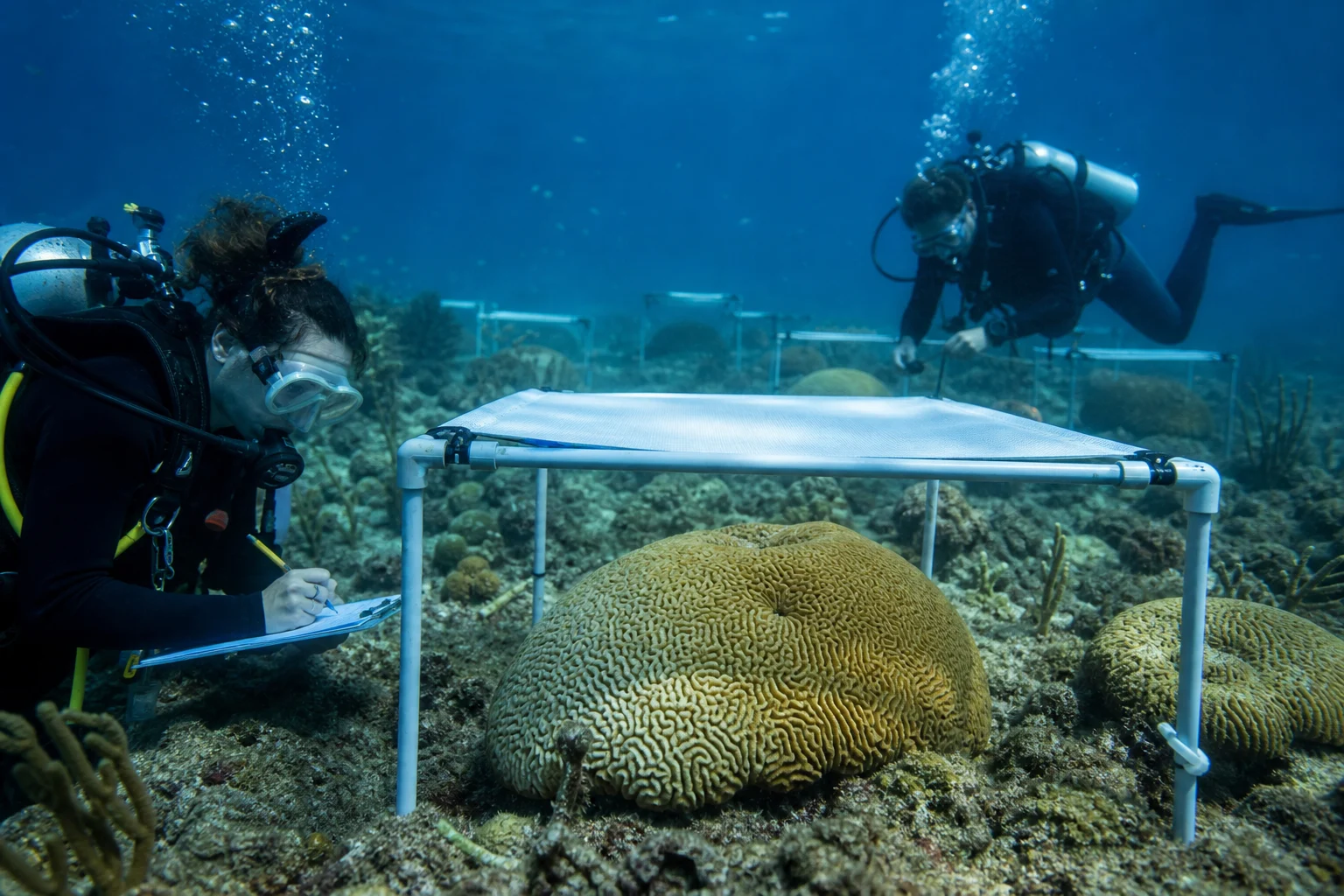
A peer-reviewed field experiment in the Florida Keys found that temporary shade structures reduced bleaching-related color loss in two brain-coral species during the region’s second-hottest summer on record.
Researchers installed 20 custom shades over portions of 10 coral colonies at Newfound Harbor during summer 2024. The study included boulder brain coral, Colpophyllia natans, and knobby brain coral, Pseudodiploria clivosa, with 20 matching corals serving as controls.
The pipe-and-nylon structures floated about 30 centimetres above the corals and reduced incoming light by approximately 60%. Shading does not lower water temperature, but it can reduce ultraviolet and high-light stress that compounds heat damage.
Scientific divers returned every two weeks to record coral color and collect small tissue biopsies. The shaded corals lost less color during the most intense heat stress, and some regained color after the shades were installed. No corals in either the shaded or control groups died during the trial.
The result is encouraging but deliberately narrow. Overall bleaching was milder than the team expected, possibly because many colonies hosted heat-tolerant Durusdinium algae after Florida’s extreme 2023 heat event. Researchers found no difference between shaded and control groups in algal density or symbiont type, and permit conditions limited where tissue could be sampled. The shades were also installed only after temperatures had already crossed a bleaching threshold.
Most importantly, the approach is not designed to cover entire reefs. Fabricating, installing, inspecting and removing individual shades requires labor and repeated diving, so the method would be most realistic for exceptionally valuable colonies, broodstock, research specimens or small restoration sites during acute heat stress.
For scientific divers, the study illustrates both the promise and operational burden of direct reef intervention. Divers are not merely installing hardware; they are responsible for secure placement, repeated condition checks, quantitative imaging and biological sampling without causing additional contact damage.
The authors describe shading as temporary, small-scale protection. It does not address the warming that drives mass bleaching, and further trials across more species and more severe heat events are needed before managers can define when the technique is worth deploying.
Connected reporting
Dive sites and aquatic life in this story
Reporting record