Diver Safety/Medicine ·
Fatal-Dive Reconstruction Shows How a Guideline Loop Can Trap and Invert a Technical Diver
A controlled underwater reconstruction found that a thin line caught around a twinset manifold could combine with buoyancy and harness changes to leave a diver head-down and severely limit self-rescue.
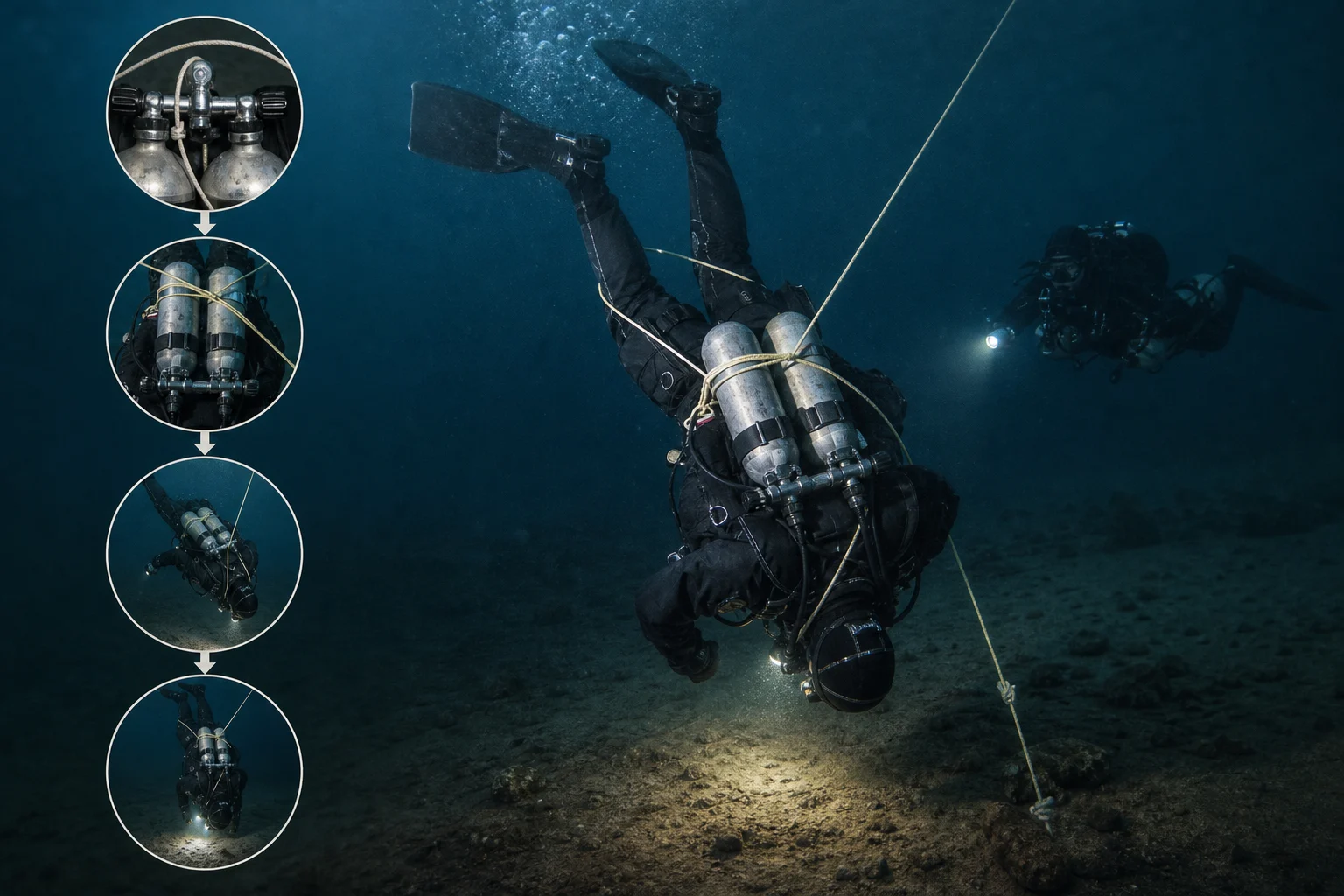
A newly published forensic report shows why investigators—and technical divers—should treat line entanglement as a dynamic equipment-and-buoyancy problem, not simply a snag that can always be cut or backed out.
The case involved an experienced 32-year-old diver who became separated from her buddy during a deep freshwater night dive. She was recovered at depth in a head-down position, with a thin guideline entangled around the central manifold valve of her twin-cylinder open-circuit set. Autopsy findings were consistent with drowning, and a technical inspection found no mechanical defect in the equipment.
Because no one witnessed the critical part of the dive, forensic specialists and a Czech police diving unit returned to controlled underwater conditions using the original breathing apparatus. They tested whether the physical evidence could be reproduced through combinations of line entanglement, buoyancy redistribution and loss of control of the twinset.
The reconstruction showed that a simple loop could form unintentionally around the central manifold while a diver attempted to free the line. With some gas in both the buoyancy compensator and drysuit, the manifold held by the line could act as a mechanical pivot and rotate the diver into a head-down position. Releasing the waist strap then allowed the breathing apparatus to shift, further impairing control and self-rescue. Those configurations matched objective features documented when the diver was recovered.
The report does not prove the exact sequence of the fatal event. It demonstrates that the proposed sequence was physically possible and consistent with the available evidence. That distinction matters: an underwater reconstruction can test a hypothesis, but it cannot supply an eyewitness account.
For technical divers, instructors and teams, the practical value is in scenario design. Entanglement drills should account for line hidden behind a manifold or twinset, unstable orientation, limited reach, and equipment movement—not only a visible line around an arm or valve. Cutting tools need to remain reachable in more than one body position, and teams should rehearse communication and assistance before a diver begins removing or loosening harness components. Deep, dark and line-managed dives also leave little margin for prolonged buddy separation.
The broader investigative lesson is equally important. Autopsy, equipment inspection and dive-computer data may not fully explain an unwitnessed fatality. Carefully controlled in-water reconstruction, performed by qualified investigators with safety support, can test whether a proposed accident sequence is mechanically credible and can turn otherwise ambiguous evidence into prevention lessons.
Reporting record