Dive Access ·
Ex-HMAS Adelaide Remains Closed After Structural Survey Confirms Major Collapse
New South Wales has not reopened the artificial-reef wreck off Avoca Beach. Its detached superstructure, unstable debris and new entrapment hazards remain under government review, with no reopening date announced.
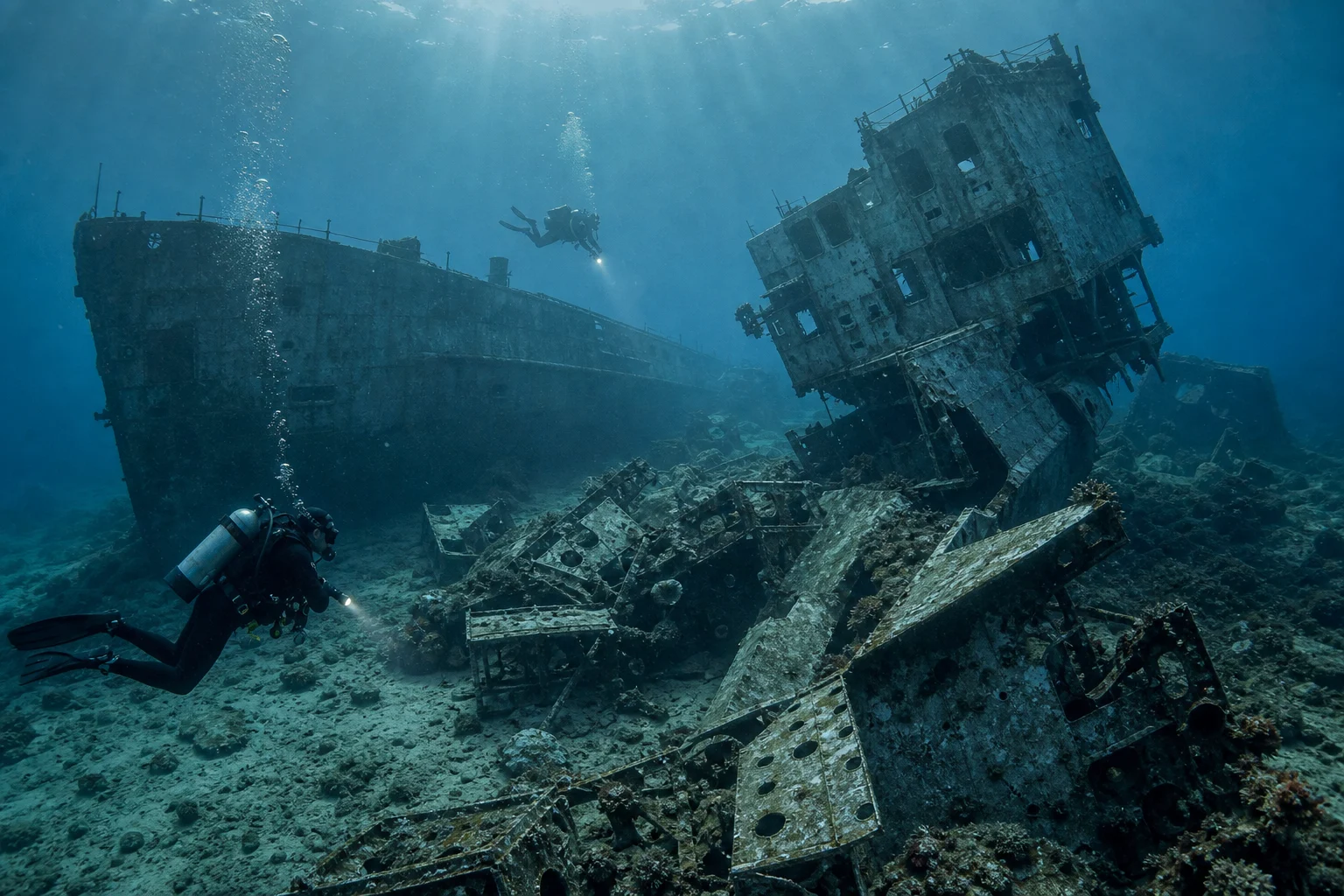
Divers planning a Central Coast wreck trip should remove the ex-HMAS Adelaide from their itineraries: the artificial-reef dive site off Avoca Beach remains closed, its mooring buoys have been removed and the New South Wales government has not announced a reopening date.
The closure began in July 2024 after storms and coastal processes damaged the scuttled former frigate. A subsequent assessment documented the complete separation and collapse of its aluminium superstructure from the steel hull. Additional storms and corrosion continued to alter the site.
A structural-condition report finalized in February 2026 gives the clearest official account of why the closure remains in place. Surveyors combined multibeam sonar, side-scan sonar and targeted inspection dives to map the wreck and surrounding debris field. The work found that large sections of the superstructure—including the bridge and O2 deck—had detached and fallen to the seabed.
The report identified loose and jagged aluminium panels, blocked or altered routes, new openings that could entrap divers and mobile debris capable of shifting under wave and current forces. Investigators also documented seabed scour and ongoing corrosion. The main steel hull was comparatively intact during the assessment, but that does not make the site safe or reopen it.
Some survey dives were deliberately limited because investigators considered deeper work unsafe until debris and detached sections were removed or stabilized. That distinction matters: official inspection activity by a specialist team under a controlled plan does not mean recreational or commercial diving is permitted.
NSW Crown Lands explicitly advises the public not to attempt to dive the site. The wreck's two yellow special navigation markers were displaced during storms and are no longer in their original positions. The mooring buoys were removed when the site closed. Private-boat access, local familiarity or previous experience on the wreck does not override the closure.
The agency is reviewing the structural report and discussing future management with Australia's federal Department of Climate Change, Energy, the Environment and Water. The engineering report outlines possible measures, including removing loose debris, controlling or demolishing unstable sections and monitoring the hull and seabed. These are management options, not a funded reopening schedule or a promise that the wreck will return to recreational use.
For dive travelers, the practical message is straightforward: do not book a charter on the assumption that ex-HMAS Adelaide access has resumed. Ask operators which alternative Central Coast or Sydney sites they are using and confirm the live government status before paying non-refundable costs.
The closure also offers a broader lesson about intentionally sunk wrecks. Preparation before scuttling can make a vessel suitable for diving at the time it is placed, but corrosion, dissimilar metals, storm loads, scour and moving debris can change the risk profile over years. Familiar penetration routes may disappear, new overhead hazards may form and depth can change as structures detach or settle.
Ex-HMAS Adelaide was sunk in 2011 as an artificial reef and recreational attraction about 1.8 kilometres off Avoca Beach. The wreck lies in approximately 30 to 32 metres of water. It remains an important marine habitat, but habitat value and dive access are separate decisions. Until NSW Crown Lands formally changes the status, the entire site should be treated as closed.
Connected reporting
Dive sites and aquatic life in this story
Reporting record