Marine Conservation ·
Coral Cores Trace Mississippi Nitrogen to Flower Garden Banks
A 270-year chemical record indicates that Mississippi-derived nitrogen now supplies most of the nitrogen reaching the remote Gulf reef, adding pressure as bleaching and disease increase.
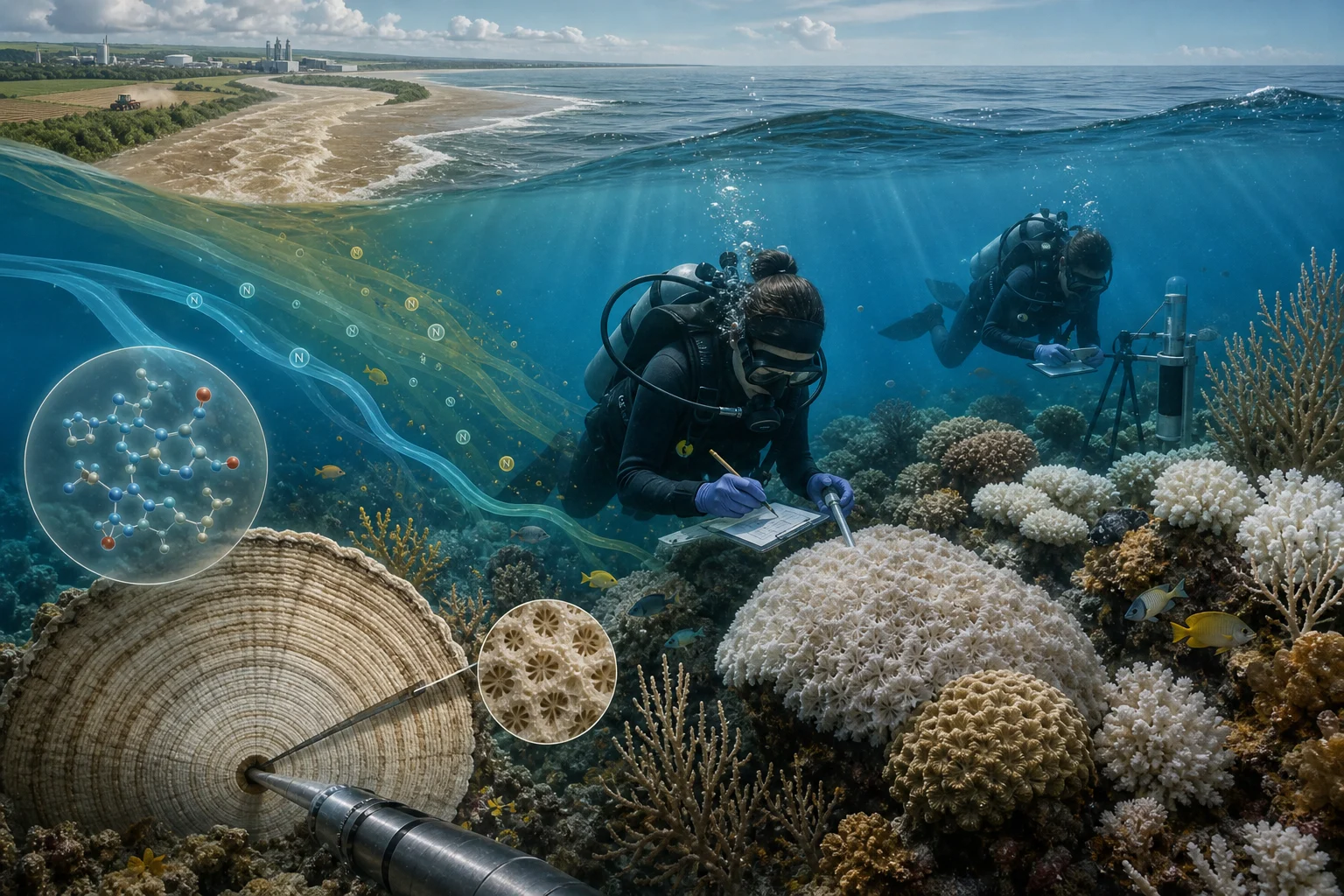
Corals at Flower Garden Banks National Marine Sanctuary have recorded a growing chemical signature from the Mississippi River basin, challenging the idea that the remote Gulf reef is insulated from land-based pollution.
An international team led by the Max Planck Institute for Chemistry and Louisiana State University analyzed coral-bound nitrogen isotopes in two star-coral cores spanning 1753 to 2023. Because the colonies add annual skeletal layers, the researchers could reconstruct changes in nitrogen sources across roughly 270 years.
The record remained close to a natural baseline until about 1850, then began reflecting agricultural expansion and other human changes in the Mississippi watershed. The signal accelerated after synthetic fertilizer use expanded in the 1960s. Modeling in the study estimates that Mississippi-derived nitrogen accounted for 30% to 50% of the nitrogen reaching the reefs by the late 20th century, exceeded 60% during the last decade and approached 80% in 2023.
Those percentages describe the estimated source contribution, not a direct measure of coral mortality. The research links the highest reconstructed nitrogen inputs with periods of heat stress, bleaching or disease in 2016 and 2022–2023, but it does not argue that nutrients acted alone. Instead, the authors identify nutrient enrichment and extreme heat as interacting pressures that can erode the resilience of a reef long regarded as one of the healthiest in the western Atlantic.
NOAA’s long-term monitoring gives that concern practical context. At East Flower Garden Bank, reef-depth temperatures exceeded 30°C for 53 days in 2023. By late September, about 28% of reef-wide coral cover was bleached and more than half was pale. Across East and West Flower Garden Bank study sites, mean coral cover nevertheless remained about 55%, underscoring both the sanctuary’s continuing strength and the value of sustained monitoring.
For divers, the study is a reminder that an offshore reef can be connected to decisions made far inland. Flower Garden Banks remains a demanding, weather-dependent liveaboard destination, but it is also a natural laboratory where scientific diving, coral coring and decades of photo-transect work reveal changes that would otherwise be invisible. Reducing watershed nutrient inputs will not produce an instant response because nitrogen stored in soils and groundwater can continue moving toward the Gulf for years.
Connected reporting
Dive sites and aquatic life in this story
Reporting record