Diver Safety/Medicine ·
Coast Guard Oriskany Report Documents Rapid Depth Changes and Missed Decompression
The closed investigation into a fatal 2020 CCR dive found that two experienced divers made repeated rapid ascents and descents before surfacing without a required stop; missing evidence leaves the cause of the initial emergency unresolved.
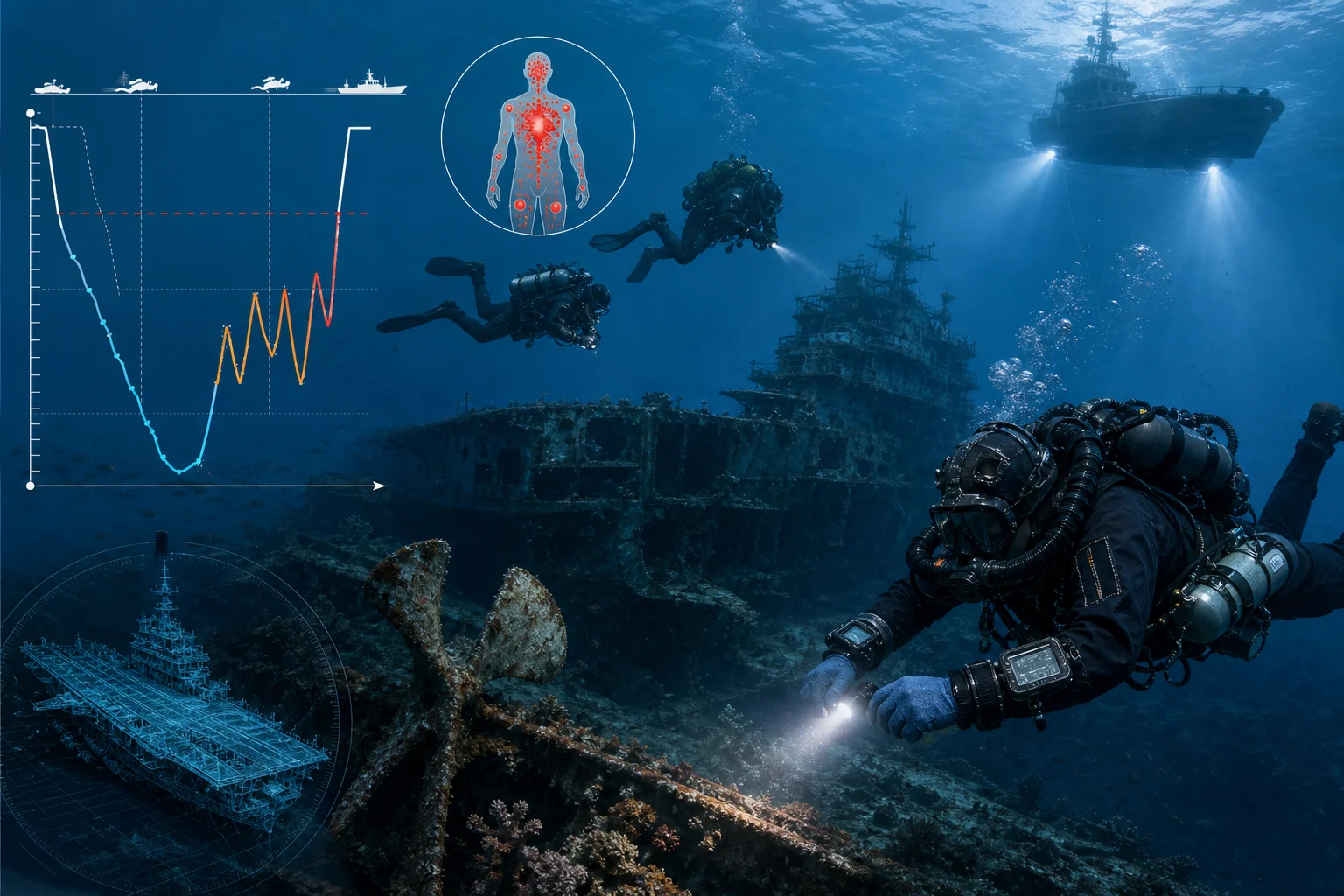
A newly published U.S. Coast Guard report reconstructs a fatal closed-circuit rebreather dive on the USS Oriskany and offers a sober lesson about how little time remains once a deep technical dive turns into an uncontrolled ascent.
The incident occurred June 1, 2020, during a charter from Pensacola, Florida. Three experienced, technically trained divers entered the water using Hollis Prism 2 closed-circuit rebreathers. They conducted an in-water bubble check, then descended toward the aircraft carrier. One diver identified a leaking gauge and separated from the team to address the problem, ultimately returning to the surface safely after being unable to relocate the other two.
The remaining pair continued to approximately 183.7 feet, where their recorded profiles show about 20 minutes at depth. They later ascended to shallower portions of the wreck. Beginning roughly 50 minutes into the dive, both computers recorded a series of rapid ascents and descents. The final sequence included an ascent from approximately 124.7 feet directly to the surface, bypassing the decompression stop indicated by their computers at about 15 metres.
The charter vessel recovered both divers at the surface. One was unresponsive; the other showed symptoms consistent with decompression sickness. Crew and passengers performed CPR on the unconscious diver and administered emergency oxygen to the surviving diver while the captain headed toward Pensacola and contacted the Coast Guard. A Coast Guard boat transferred both casualties, and the survivor was flown for hyperbaric treatment. The other diver was pronounced dead after reaching shore.
An autopsy listed arterial gas embolism due to rapid ascent as the cause of death. The Coast Guard identified failure to complete the computer-recommended decompression stop as the causal factor in the casualty. The report also records that the surviving buddy, who followed the same profile, required hyperbaric treatment.
That official conclusion does not explain why the divers began making abrupt depth changes. Because the investigation was completed years after the incident, breathing-gas cylinders and other important evidence were no longer available. The Coast Guard therefore said it could not rule out equipment failure or nitrogen narcosis as possible contributors. The report does not establish that either rebreather malfunctioned, and it should not be read as a product finding.
The investigation found no evidence of actionable misconduct by Coast Guard-credentialed mariners, no criminal or civil violations and no need for new regulation. It also states that the vessel’s accident-management plan was aboard and followed. No new safety or administrative recommendations were issued.
For technical divers, the practical lesson is larger than simply “obey the computer.” Repeated depth reversals during decompression can rapidly destabilize a plan and may signal that a buddy is impaired, entangled, managing a buoyancy problem or responding to an equipment emergency. Teams need rehearsed procedures for aborting the dive, stabilizing depth, communicating, switching to bailout when required and preserving enough gas to complete a controlled ascent.
If a diver surfaces after a rapid ascent or omitted decompression, the response should move immediately to surface-level emergency oxygen, emergency medical services and consultation with a diving-medicine resource such as DAN. Symptoms can appear quickly, and an unconscious or neurologically impaired diver requires urgent evacuation. Descending again to improvise decompression is not a substitute for an established, training-agency emergency procedure and can expose the diver to additional risk.
The Oriskany remains an advanced and, at greater depths, technical wreck dive. Experience and certification matter, but this case involved highly experienced divers. The report’s enduring lesson is that a deep wreck team needs layered safeguards, conservative limits and a practiced response for the moment the planned profile stops being the profile actually being dived.
Connected reporting
Dive sites and aquatic life in this story
Reporting record