Underwater Exploration & Science ·
Active Underwater Crater Discovered Near Panarea Reshapes View of Volcanic System
Multibeam mapping and an ROV survey have revealed a 100-by-60-metre crater and previously undocumented hydrothermal vents at 60–80 metres, with intense degassing creating sharply different biological communities.
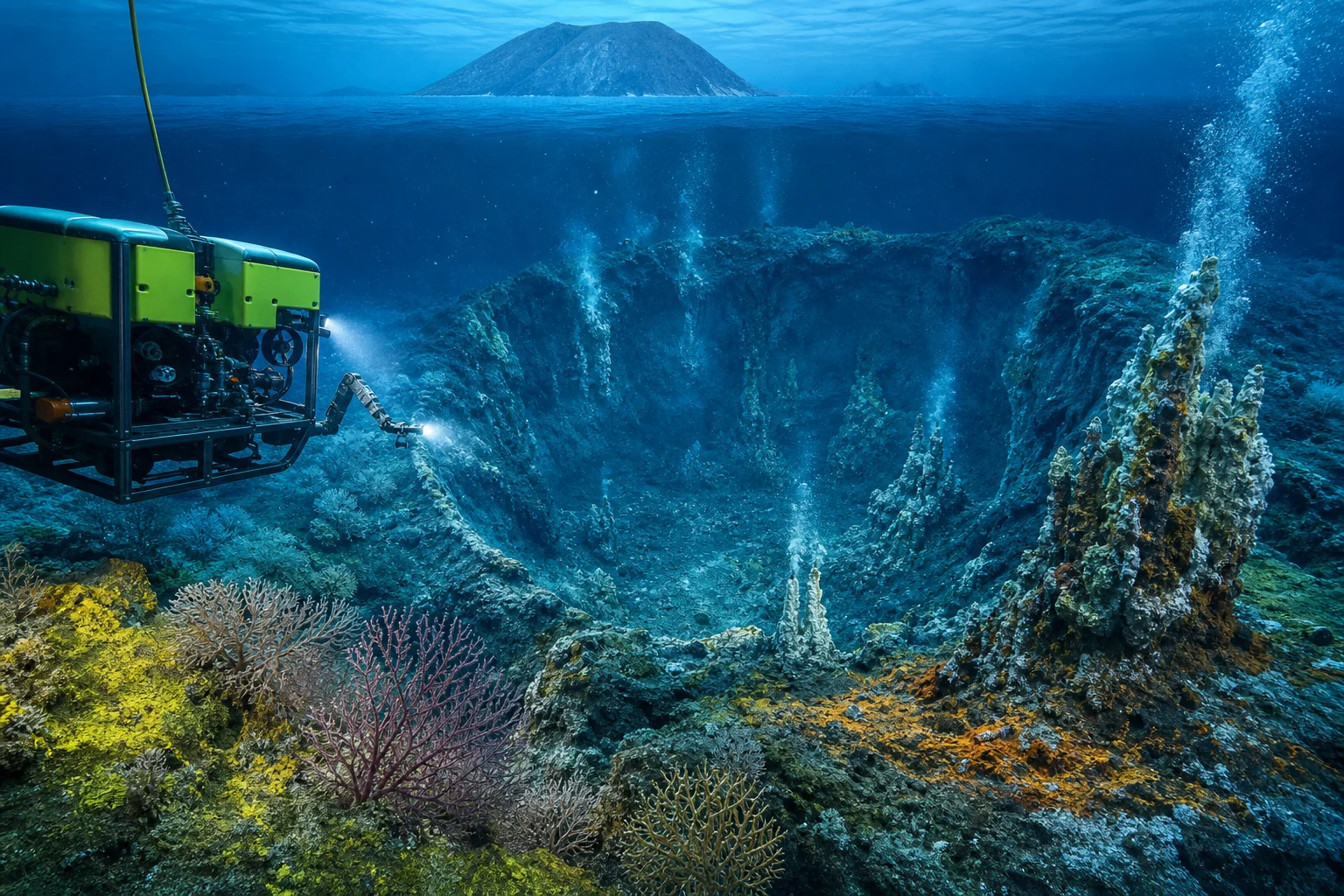
Scientists have discovered a large underwater crater and new hydrothermal vents near Panarea, expanding the known boundaries of the active submarine system surrounding the smallest inhabited island in Italy’s Aeolian archipelago.
The newly documented crater measures approximately 100 by 60 metres and lies about 1.5 kilometres northeast of Panarea at depths between 60 and 80 metres. The Italian National Institute of Geophysics and Volcanology, or INGV, announced the discovery on August 5, 2026.
Researchers first identified unusual seafloor shapes in multibeam-sonar data collected through the IDMAR marine-research infrastructure. Geographic-information-system analysis suggested that the structures could be pathways carrying hydrothermal fluids upward through the seabed.
A direct investigation followed in July. An ROV supplied by the University of Padua and operated by Marco Munari of the Anton Dohrn Zoological Station confirmed intense gas emissions inside the crater. Degassing was visible along its walls and across the deepest part of the floor.
The survey also documented hydrothermal chimneys with signs of recent activity and high gas-emission rates. Their shape resembles vents at the nearby Smoking Land field, discovered in 2015 south of the islet of Basiluzzo.
The discovery matters because it suggests Panarea’s hydrothermal system extends farther than previously mapped. The crater and vents lie along a northeast-to-southwest tectonic alignment connecting Panarea with Basiluzzo. Scarps documented during the survey indicate that this structure provides a preferred route for gases and deep fluids to reach the seabed.
Researchers say the expanded system will need to be incorporated into future volcanic monitoring and hazard assessments. The announcement does not describe an imminent eruption or new public emergency; it identifies an active area whose dynamics, energy and environmental effects require further study.
ROV imagery also revealed how strongly hydrothermal activity shapes marine habitat. Around chimneys with lower activity, researchers observed green macroalgae and colonies of the gorgonian Eunicella singularis. Inside the crater, where degassing is more intense, broad bacterial mats dominate while macroalgae and attached animals are largely absent.
That contrast makes the site a potential natural laboratory for studying how organisms respond to chemically and physically extreme environments. INGV and the Anton Dohrn Zoological Station say future work could combine volcanology, biology and ecology to examine biodiversity, climate-related stress and adaptation.
For the diving community, the depth range is conspicuous: 60 to 80 metres falls within advanced technical-diving territory. However, this discovery was verified by ROV, not opened as a dive attraction. Active gas discharge, volcanic setting, uncertain local conditions and the absence of published access guidance make it inappropriate to present the crater as a destination.
The story instead belongs in underwater exploration, scientific research and marine technology. Multibeam mapping found the anomaly, GIS analysis helped interpret it and a tethered vehicle provided visual confirmation without exposing divers to an incompletely understood active environment.
Naturally Buoyant Media should track future research expeditions, bathymetric mapping, gas chemistry, biological surveys and any official hazard or access guidance. A Dive Site record would be premature unless Italian authorities later establish that diving is lawful, environmentally appropriate and operationally safe.
The discovery is a reminder that substantial features remain undocumented even close to well-known inhabited islands. It also shows why modern exploration increasingly combines remote sensing and robotics before humans enter demanding or potentially hazardous water.
Connected reporting
Dive sites and aquatic life in this story
Reporting record